
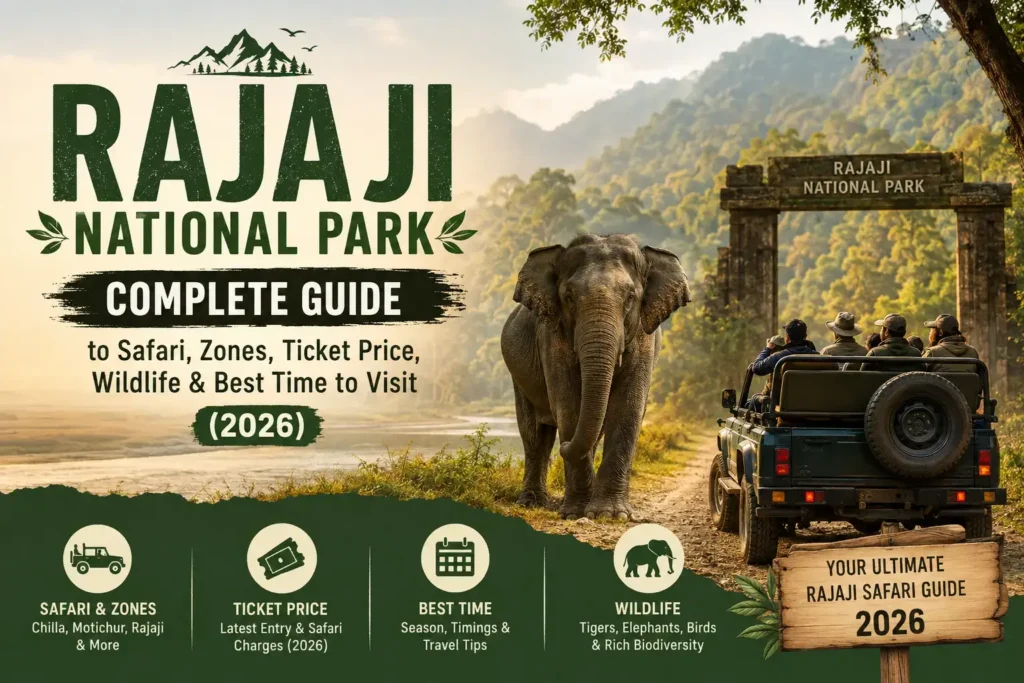
Rajaji National Park is a 820 sq. km tiger reserve tucked into the Shivalik foothills of Uttarakhand, wedged almost literally between two of India’s most visited towns — Haridwar and Rishikesh — and a short drive from Dehradun. Officially known as Rajaji Tiger Reserve since 2015, it is one of the few protected tiger habitats in India you can visit on a half-day trip without giving up your hotel room in a pilgrim or yoga town. The park is best known for its exceptional Asian elephant population, a recovering tiger presence (including a notable 2020–2025 translocation project from Corbett), leopards, over 300 recorded bird species, and landscapes that range from Sal forest and open grassland to the Ganga’s riverine belt. This guide covers everything a first-time visitor needs — zones, safari costs, timings, best season, how to reach it from Rishikesh, Haridwar and Dehradun, and what to realistically expect from a safari — cross-checked against multiple sources so you can plan with confidence.
Rajaji National Park at a Glance
| Detail | Information |
|---|---|
| Location | Shivalik Hills, Uttarakhand — spans Haridwar, Dehradun & Pauri Garhwal districts |
| State | Uttarakhand, India |
| Area | ~820 sq. km (core); Tiger Reserve total ~1,075 sq. km with buffer |
| Established | 1948 (Rajaji Wildlife Sanctuary) → 1983 (National Park, after merging Rajaji, Motichur & Chilla sanctuaries) → 2015 (Tiger Reserve, 48th in India) |
| Famous for | Asian elephants, recovering tiger population, leopards, Ganga riverine landscape, 300+ bird species |
| Major wildlife | Bengal tiger, Asian elephant, leopard, sloth bear, sambar, spotted deer, barking deer, Barasingha (swamp deer), Himalayan goral, king cobra, gharial |
| Safari zones | Chilla, Motichur, Jhilmil Jheel, Ranipur, Mohand (Chillawali) — plus buffer ranges like Gohri |
| Safari type | Open Gypsy/jeep safari (shared or private); elephant rides are not offered inside the park |
| Season | Mid-November to mid-June (Jhilmil Jheel sometimes extends to end-June); closed during monsoon |
| Nearest cities | Haridwar (~8–10 km to Chilla/Motichur gates), Rishikesh (~18–20 km), Dehradun (~50–56 km) |
| Nearest airport | Jolly Grant Airport, Dehradun (~35–40 km from Haridwar-side gates) |
| Nearest railway station | Haridwar Junction (closest to Chilla/Motichur); Dehradun and Rishikesh stations also usable |
| Safari duration | Roughly 2.5–3.5 hours per session |
| Booking | Uttarakhand Forest Department online safari booking portal, or in person at the zone gate subject to availability |
Fees, exact timings and seasonal dates below reflect the most recent information available at the time of writing and are known to change by Forest Department notification — always reconfirm before you travel.
History of Rajaji National Park
The land that is now Rajaji National Park began life as three separate protected areas: Rajaji Wildlife Sanctuary (notified 1948, to protect Shivalik elephant migration corridors), Motichur Wildlife Sanctuary (carved out of Dehradun forests, protecting dense Sal forest near Haridwar), and Chilla Wildlife Sanctuary (covering the eastern Ganga bank forests). On 29 November 1983, under the Wildlife Protection Act of 1972, these three sanctuaries were amalgamated into a single Rajaji National Park.
The park is named after Chakravarti Rajagopalachari, popularly known as “Rajaji” — a leading independence-movement figure, India’s last Governor-General before it became a republic, founder of the Swatantra Party, and a Bharat Ratna recipient. It was decided to name the sanctuary after him in recognition of his role in protecting this landscape from being opened up for hunting in the years after independence.
On 20 April 2015, Rajaji was formally declared a Tiger Reserve — India’s 48th and Uttarakhand’s second, after Corbett — bringing it under Project Tiger. It is also designated under Project Elephant, reflecting its importance as the north-western distribution limit of both the Asian elephant and the Bengal tiger in India.
Rajaji National Park vs Rajaji Tiger Reserve: these are the same protected area under two names. “Rajaji National Park” refers to the core notified park (~820 sq. km); “Rajaji Tiger Reserve” is the current official designation and includes an additional buffer zone, taking the total managed area to roughly 1,075 sq. km. In everyday use — and in this guide — the two names are interchangeable.
About Rajaji National Park
Rajaji sits at the point where the Himalayan foothills give way to the Indo-Gangetic plains, spanning elevations from around 300 to 1,400 metres. This transition zone is what makes the park ecologically distinctive: within a single safari you can pass through dense Sal (Shorea robusta) forest, dry deciduous woodland, open grasslands (locally called chaurs), scrubland with lantana, and riverine belts along the Ganga, which flows through the park for roughly 24 km and effectively divides it into an eastern and a western sector.
This mosaic of habitats supports elephant corridors that link Rajaji to the wider Rajaji–Corbett Elephant Reserve and the larger Terai Arc Landscape, one of the most significant tiger-and-elephant conservation corridors in Asia. The park also functions as a green lung for Dehradun, Haridwar and Rishikesh, buffering these fast-growing cities from the plains’ heat and pollution.
Why Is Rajaji National Park Famous?
Rajaji’s reputation rests on a few specific things:
- Asian elephants: one of the largest and most reliably visible wild elephant populations in northern India, concentrated in an unusually accessible landscape.
- A tiger recovery story: Rajaji represents the north-western edge of the Bengal tiger’s global range, and its western sector has been the site of a genuine conservation success story (see the Tigers section below).
- Leopards: the reserve supports some of the highest recorded leopard densities of any Indian protected area.
- Birdlife: over 300 recorded species, including the Great Hornbill near its western range limit.
- The Ganga riverine landscape: few Indian tiger reserves combine forest safari with a major river ecosystem the way Rajaji does.
- Sheer accessibility: most tiger reserves in India require a dedicated multi-day trip; Rajaji can be added to an existing Haridwar or Rishikesh itinerary.
It’s worth being upfront about something most brochures skip: wildlife sightings in Rajaji, as in any wild forest, are never guaranteed. Animal movement depends on season, water availability, temperature, recent rainfall and simple chance. A guide who tells you “you will see a tiger” is overselling the experience — a good guide instead helps you understand where and when sightings are statistically more likely.
Rajaji National Park Safari
A Rajaji safari is done in an open-top Gypsy (jeep), either private or on a shared basis, driven by an authorised driver and typically accompanied by a Forest Department-authorised naturalist guide. There are two daily sessions — morning and evening — timed around sunrise and sunset so wildlife activity coincides with visiting hours. Each vehicle carries a maximum of six visitors; sharing between unrelated groups is generally not permitted.
What to expect on entry: you’ll show your booking confirmation or permit and valid photo ID at the gate, undergo a basic check, and enter with your assigned guide. Straying from the vehicle, feeding animals, and using flash photography near animals are prohibited (see the Safari Rules section).
Why a trained local guide matters: beyond spotting camouflaged wildlife, an experienced local guide reads terrain and animal signs — fresh pugmarks, alarm calls from langurs or deer, disturbed water at a waterhole — that a first-time visitor would simply drive past. This is genuinely the single biggest factor separating an average safari from a memorable one, more than which zone you pick.
Rajaji National Park Safari Zones
Rajaji is not one continuous safari circuit — it’s managed through separate, individually bookable zones, each with its own gate, route and character. Don’t assume every forest range you read about online is open and bookable for tourists; some are buffer ranges with limited or no general visitor access.
| Zone | Best Known For | Habitat | Wildlife | Best For | Accessibility | Seasonal Status |
|---|---|---|---|---|---|---|
| Chilla | Elephants, tiger presence, river views | Sal forest, riverine grassland, Ganga bank | Elephant, tiger, leopard, deer, hornbills | First-time visitors, best all-round chance of sightings | ~8–10 km from Haridwar, ~18–20 km from Rishikesh | Nov 15 – Jun 15 (fills fast in peak season) |
| Motichur | Leopards, birdlife, dense Sal | Dense Sal forest, mixed woodland | Elephant, leopard, deer, extensive birdlife | Families, birdwatchers | ~8–9 km from Haridwar, on the Haridwar–Rishikesh highway | Nov 15 – Jun 15 |
| Jhilmil Jheel | Wetland habitat, Barasingha | Terai marshland, grassland, watchtower views | Barasingha (swamp deer), waterbirds, elephant, reptiles | Birdwatchers, photographers, quieter safari | Near Haridwar | Often extended to Jun 30 (confirm current dates) |
| Ranipur | Remoteness, low crowds | Forest with historical Forest Rest House sites | Deer, Himalayan goral, birdlife | Visitors wanting a quieter, less commercial experience | Near Haridwar | Nov 15 – Jun 15 |
| Mohand (Chillawali) | Dehradun-side access, leopard sightings | Forest and hill terrain near Mohand | Leopard, deer, varied birdlife | Dehradun-based visitors | ~20 km from Dehradun | Nov 15 – Jun 15 |
| Gohri (buffer range) | Year-round access | Buffer forest | General wildlife, lower density | Off-season visitors | Varies | Reported to stay open longer than core zones — confirm locally |
A few terminology notes worth knowing before you book: Andheri and Satyanarayan/Kansro appear on some sites as newer safari entry points associated with the Chilla and Motichur ranges respectively — treat these as sub-routes or gates within the main zones rather than entirely separate parks, and confirm with the booking portal which official zone name they fall under. Mohand and Chillawali are often used for the same Dehradun-side zone. Not every forest range inside the Tiger Reserve (for example parts of the wider buffer) is open for general tourist safari — if a name isn’t on the official zone list at booking time, don’t assume it’s bookable.
Chilla Zone
Chilla is Rajaji’s flagship zone and the busiest gate in the park, located roughly 8–10 km from Haridwar and 18–20 km from Rishikesh, right along the road connecting the two cities. It sits on the eastern bank of the Ganga and offers the park’s most varied single-safari habitat: open grassland, riverine belt, dense Sal forest and rocky hill terrain. This is also the zone that historically holds the healthier of Rajaji’s two tiger populations (see Tigers section) and records the highest elephant sighting frequency in the park, along with regular leopard, deer and hornbill sightings. Because it’s the most convenient and best-known zone, book Chilla well in advance during December–March — slots here fill fastest.
Motichur Zone
Motichur sits about 8–9 km from Haridwar on the Haridwar–Rishikesh highway and was one of the three original sanctuaries that formed Rajaji. It’s dominated by dense Sal forest and is considered one of the better zones for leopard sightings and general birdwatching, with a somewhat calmer, less crowded safari experience than Chilla. Families often prefer it for exactly this reason.
Jhilmil Jheel Zone
Jhilmil Jheel is different in character from every other zone — a roughly 155-hectare (383-acre) marshy Terai grassland near Haridwar, described by park literature as one of the last pieces of untouched primordial Terai marshland left in Uttarakhand. It is the last stronghold in Uttarakhand for the Barasingha (swamp deer), an endangered species, and its watchtower offers panoramic views over the wetland. This is the zone of choice for birdwatchers and photographers rather than tiger-seekers, and reptile sightings (including crocodiles, where present) are more likely here than in the drier zones. It’s also the one zone whose season is sometimes extended a couple of weeks beyond the main park’s mid-June closing date — confirm current dates before planning a late-season visit.
Ranipur Zone
Ranipur is the quietest and least commercialised of Rajaji’s zones, historically associated with old Forest Rest House sites from the British era. Fewer visitors means shorter queues and a calmer overall pace, plus a genuine chance of Himalayan goral (a hill-dwelling relative of the wild goat) alongside more common deer species. It’s a good pick if you’ve already done a busier zone like Chilla and want something more contemplative on a second safari.
Mohand / Chillawali
Located on the Dehradun side of the park, roughly 20 km from the city, Mohand (also referred to as Chillawali) is the most convenient zone for visitors based in Dehradun rather than Haridwar or Rishikesh. It runs a longer circuit than some other zones and is known for leopard sightings, dense forest and hill scenery, offering a different visual character from the Ganga-belt zones.
Gohri / Buffer Areas
Gohri is generally described as a buffer range of the reserve rather than a core tourist zone, with some reports suggesting it stays accessible for longer through the year than the core zones. Treat any buffer-area safari as a secondary, lower-density-wildlife option rather than your primary choice, and confirm current access rules directly with the Forest Department or booking portal, since buffer-zone tourist policy is the part of Rajaji’s structure most likely to change without much online documentation.
Which Zone Is Best for Rajaji National Park Safari?
There’s no single “best” zone — it depends on what you’re optimising for:
- First-time visitors / best overall chance of varied sightings: Chilla
- Best for elephants: Chilla and Motichur
- Best for birdwatching: Jhilmil Jheel, followed by Motichur
- Best for wetland habitat and Barasingha: Jhilmil Jheel
- Best for photographers wanting fewer people in frame: Ranipur or Jhilmil Jheel
- Best for a quieter safari: Ranipur
- Best from Rishikesh: Chilla (shortest, most direct drive)
- Best from Haridwar: Chilla or Motichur (both under 10 km)
- Best from Dehradun: Mohand (Chillawali)
- Best for wildlife enthusiasts wanting the “full” Rajaji experience over two days: Chilla in the morning, followed by Jhilmil Jheel or Motichur on a second session
No zone can promise a tiger or leopard sighting — treat “best zone” as “best odds and best-fit habitat,” not a guarantee.
Animals Found in Rajaji National Park
Big Cats
- Bengal Tiger (Panthera tigris tigris)
- Leopard (Panthera pardus)
Herbivores
- Asian Elephant (Elephas maximus)
- Spotted Deer / Chital
- Sambar
- Barking Deer (Muntjac)
- Wild Boar
- Barasingha / Swamp Deer (Rucervus duvaucelii) — restricted mainly to Jhilmil Jheel
Primates
- Hanuman Langur
- Rhesus Macaque
Other Mammals
- Sloth Bear
- Himalayan Goral (in hillier zones such as Ranipur)
- Jackal
Reptiles
- King Cobra
- Indian Python
- Monitor Lizard
- Gharial and Mugger Crocodile (in and near the Ganga riverine stretch — sightings are opportunistic, not guaranteed on every safari)
The presence of a species in the park does not mean it will be seen on a given safari — reptiles in particular are far less predictably encountered than deer or birds.
Birds of Rajaji National Park
Rajaji is one of North India’s better birding destinations, with published records ranging from roughly 300 to 315+ species, including resident, winter migratory and altitudinal migrant birds. Notable species include:
- Great Hornbill (near the western limit of its range) and other hornbill species
- Pallas’s Fish Eagle and other raptors
- Multiple kingfisher species
- Indian Peafowl
- Woodpeckers
- A wide range of waterbirds, especially around Jhilmil Jheel
Winter (roughly December–February) is generally the best period for birdwatching, as migratory species arrive alongside residents and cooler temperatures keep birds active for longer through the day.
Tigers in Rajaji National Park: Are There Tigers?
Yes — but the story is more interesting, and more honest, than a flat population number.
The Ganga effectively splits Rajaji’s tiger habitat into two sectors. The eastern sector (Chilla and adjoining ranges) has long held a healthier tiger population, historically reported in the range of roughly 35–50 individuals depending on the year and survey. The western sector (Motichur and beyond), despite having suitable habitat estimated to support 80 or more tigers, held only two resident tigresses for over a decade — the pair’s population had effectively collapsed by the mid-2010s, largely because a railway line and national highway between the two sectors blocked natural tiger movement between them.
To fix this, the Uttarakhand Forest Department — with the NTCA, Wildlife Institute of India and WWF-India — ran one of India’s first tiger translocation programmes, moving tigers individually from Corbett Tiger Reserve’s buffer zone into western Rajaji between December 2020 and May 2025. Five tigers were translocated in total. In a genuinely significant conservation milestone, one of the translocated tigresses gave birth to four cubs, confirmed by the Uttarakhand Forest Minister in 2024–25 — the first evidence of natural tiger breeding in western Rajaji in years.
What this means for a visitor: tiger sightings are more likely, though still far from guaranteed, in Chilla and the eastern sector, while western-sector sightings remain rarer as the reintroduced population re-establishes itself. Given how recent and fragile this recovery is, treat any specific tiger-count claim you see online (including in this article) as an approximation, not a census figure — and never expect a sighting to be guaranteed by any operator.
Asian Elephants in Rajaji National Park
Rajaji is, arguably, more reliably an elephant destination than a tiger one. It sits on the north-western limit of the Asian elephant’s range in India and is part of the wider Rajaji–Corbett Elephant Reserve, one of the country’s most important elephant corridors linking Himalayan foothill forest to Terai lowland habitat. Elephants move seasonally along established corridors between water sources and feeding grounds, and herds — sometimes with calves — are regularly encountered in the Chilla and Motichur zones, particularly near water in the warmer months (March–May) when herds concentrate around remaining water bodies.
Responsible viewing matters here more than with almost any other species. Wild elephants can be unpredictable, especially cows with young calves or lone bulls in musth. Rajaji safaris keep a mandatory safe distance and never approach an elephant on foot — always stay inside the vehicle, keep noise down, and follow your guide’s instructions immediately if they indicate the vehicle needs to reverse or move away.
Best Time to Visit Rajaji National Park
| Period | Weather | Safari Availability | Wildlife Experience | Best For |
|---|---|---|---|---|
| November | Cool, pleasant, park just reopened | Open (season starts Nov 15) | Good — animals adjusting after monsoon | Early-season visitors, fewer crowds than peak winter |
| December – January | Cold mornings, clear days | Fully open, peak season | Good general sightings; birding excellent | Birdwatchers, comfortable daytime safaris |
| February | Mild, warming | Fully open | Good | Families, first-time visitors |
| March | Warming rapidly | Fully open | Improving as water sources shrink and animals concentrate | Wildlife photographers |
| April – May | Hot, dry | Fully open until mid-June | Often the best window for tiger/elephant sightings, as animals gather near remaining waterholes | Serious wildlife-sighting-focused visitors comfortable with heat |
| Mid-June – Mid-November | Monsoon | Park closed to core-zone safaris | N/A | Not recommended — roads become impassable and it’s a conservation/breeding period |
Key distinction: “Best time to visit Rajaji” (comfort, weather, general travel) and “best time for wildlife sightings” (hot, dry pre-monsoon months) are not the same window — decide which one matters more to your trip. Also remember that park-wide closure dates and individual zone opening/closing dates can differ slightly (Jhilmil Jheel, for instance, has sometimes stayed open a couple of weeks past the main mid-June closure) — always check the specific zone you intend to visit.
Rajaji National Park Safari Timings
Safari sessions run twice daily, timed to sunrise and sunset:
- Morning safari: typically begins around 6:00 AM in peak winter season, with gates opening on time and a fixed reporting window before departure.
- Evening safari: typically begins in the early-to-mid afternoon, again timed to allow a full session before sunset.
Exact clock times shift through the season as sunrise/sunset times change, and can also vary slightly by zone. Do not treat any specific time quoted online — including in this article — as fixed; confirm your exact reporting time when your permit/booking is confirmed, or by calling the relevant zone gate office the day before your safari. Arriving even a few minutes after the gate closing window can mean forfeiting your slot.
Rajaji National Park Ticket Price & Safari Cost
Costs are set and periodically revised by the Uttarakhand Forest Department, and different sources online currently quote somewhat different figures — a sign that this is genuinely due for reconfirmation rather than something to guess at. Based on cross-checking multiple current sources, the approximate 2025–26-season structure looks like this:
| Cost Component | Indian Visitor | Foreign Visitor | Notes |
|---|---|---|---|
| Entry Fee (per person) | ₹150 (approx.) | ₹600 (approx.) | Charged to every visitor, whether or not you take a jeep safari |
| Gypsy/Jeep Safari (per vehicle, up to 6 people) | ₹2,500–3,500 (approx.) | ₹4,000–4,500 (approx.) | Varies by zone and by whether you book privately or join a shared vehicle |
| Vehicle/Road Entry Fee | ₹250–300 (approx.) | ₹500 (approx.) | Separate from the per-person entry fee |
| Guide Fee | ₹600–1,000 (approx.) | ₹600–1,500 (approx.) | Mandatory for all vehicle entries in most zones |
| Camera Permit (DSLR/mirrorless still photography) | Free–₹200 (approx.) | ₹50–500 (approx.) | Video/movie cameras generally cost more than stills |
This is the single most important caveat in this entire guide: fees can and do change by Forest Department notification, sometimes without much advance online notice. Different websites currently show different numbers for the same fee. Rather than presenting one figure as gospel, confirm the exact current tariff either on the official Uttarakhand Forest Department safari booking portal or by calling the specific zone’s gate office before you finalise your budget or make a payment.
How to Book Rajaji National Park Safari
- Select your date — ideally at least a few days ahead in peak season (Nov–Feb), when popular zones fill quickly.
- Select your safari zone — Chilla, Motichur, Jhilmil Jheel, Ranipur or Mohand, based on what you want to see (see the zone-comparison section above).
- Select your safari session — morning or evening.
- Provide visitor details — full names, ages and nationality for everyone in your group.
- Provide ID details — Indian nationals typically need Aadhaar or Voter ID; foreign nationals need passport details.
- Select your vehicle — a shared Gypsy (if available) or a private Gypsy booking.
- Confirm your guide/driver — most zones require an accompanying authorised guide; this is usually arranged as part of the booking.
- Pay the applicable charges — entry fee, vehicle fee, guide fee and any camera permit, either online in advance or in cash/digital payment at the gate for walk-in bookings (subject to availability).
- Receive your permit — typically issued as an email confirmation for online bookings, or a printed slip for gate bookings.
- Report at the entry gate — arrive well before your session’s reporting deadline with your permit and original photo ID.
Booking channels: the Uttarakhand Forest Department’s official online safari booking portal is the recommended route, especially for Chilla and Motichur in peak season when same-day walk-in slots often sell out. Offline booking counters exist at the main gates (Chilla, Motichur) for walk-in visitors, subject to availability after online bookings are accounted for. If you book through a travel agent or authorised operator, confirm they are working with official Forest Department rates rather than charging an unexplained premium.
Cancellation: policies are set by the Forest Department and can vary; as a general pattern, cancelling well in advance (a week or more before your date) tends to get a fuller refund than a last-minute cancellation, and very last-minute cancellations are often non-refundable. Confirm the exact policy at the time of booking.
Documents Required for Rajaji Safari
- Indian nationals: Aadhaar Card, Voter ID, Driving Licence or another accepted government photo ID
- Foreign nationals: a valid passport is the standard requirement
Carry the original document, not just a photo of it, and make sure names on the booking exactly match the ID you’ll present at the gate.
How to Reach Rajaji National Park
By Air
The nearest airport is Jolly Grant Airport, Dehradun, roughly 35–40 km from the Haridwar-side gates (Chilla/Motichur) and closer still to the Mohand zone. It has regular daily flights connecting to Delhi and other major Indian cities.
By Train
Haridwar Junction is the closest major railway station to the Chilla and Motichur gates (roughly 8–10 km away) and is well connected by direct trains from Delhi, Mumbai, Kolkata, Lucknow and other cities. Dehradun and Rishikesh railway stations are also usable depending on which zone you’re visiting.
By Road
Rajaji is well connected by national highway and state road from Delhi (approximately 220–250 km, roughly 5–7 hours by car), Haridwar, Rishikesh and Dehradun. Regular buses and taxis run between these towns and the park gates.
Rajaji National Park from Rishikesh
The Chilla Gate is the most convenient and popular entry point from Rishikesh, roughly 18–20 km away (about 35–45 minutes by road), along a scenic route that runs alongside the Chilla Dam canal. If you’re staying near Ram Jhula or Lakshman Jhula, plan to leave your hotel at least an hour before your safari’s reporting time to allow for the drive plus a buffer at the gate — for a 6:00 AM morning session in peak winter, that generally means departing by around 5:00–5:15 AM. A taxi or a rented scooter/bike are both common options for the drive; if self-driving after an evening safari, be alert for wild elephants that occasionally cross roads near the park boundary after dark.
Rajaji National Park from Haridwar
Haridwar is the single most convenient base for a Rajaji safari — the Chilla and Motichur gates are both roughly 8–10 km away, a 20–30 minute drive. Ranipur and Jhilmil Jheel are slightly further, around 15 km. Because of the short distance, Haridwar-based visitors have more flexibility on departure timing than those coming from Rishikesh or Dehradun, and it’s realistic to combine a morning Rajaji safari with an afternoon or evening back in the city for Ganga Aarti at Har Ki Pauri.
Rajaji National Park from Dehradun
From Dehradun, the Mohand (Chillawali) zone, roughly 20 km away, is the most convenient option, though visitors wanting Chilla or Motichur specifically should budget for a longer drive of around 50–56 km (roughly 1.5–2 hours) via Haridwar. If tiger and elephant sightings in Chilla are your priority over convenience, it’s worth the extra driving time; if a shorter trip matters more, Mohand is the practical choice for a Dehradun base.
Where to Stay
Accommodation for a Rajaji visit is typically organised around the nearest city rather than inside the park itself:
- Haridwar — the widest range of hotel options and the shortest drive to Chilla/Motichur gates; good if your trip also involves Ganga Aarti or other Haridwar sightseeing.
- Rishikesh — popular with visitors combining Rajaji with yoga, rafting or general Rishikesh tourism; slightly longer drive to Chilla than from Haridwar.
- Near Chilla / forest-edge stays — some resorts and forest-adjacent properties operate close to the Chilla gate itself, useful if you want to minimise pre-dawn travel time for a morning safari.
- Dehradun — sensible if your trip is centred on the city or you’re flying via Jolly Grant, though it means a longer drive to the more popular Haridwar-side zones.
This guide does not recommend specific hotel names or rates, since availability and pricing change constantly — check current listings closer to your travel date.
Things to Do in Rajaji National Park
- Jeep (Gypsy) safari across one or more zones
- Wildlife and landscape photography
- Birdwatching, especially at Jhilmil Jheel and Motichur
- General nature observation and forest walks where permitted with a guide
- Elephant watching along the Ganga corridor and near seasonal waterholes
- Combining a safari with nearby Rishikesh (rafting, yoga) or Haridwar (Ganga Aarti) sightseeing on the same trip
What to Carry
- Government-issued photo ID (original, not a photo)
- Water
- Sunglasses
- Hat or cap
- Binoculars (genuinely useful for birdwatching zones like Jhilmil Jheel)
- Camera, with extra battery or a power bank
- A light jacket, especially for early winter morning safaris when temperatures can be surprisingly cold
- Comfortable, neutral-coloured clothing
- Sunscreen
- Any personal medicines you need
- Cash, in case a gate or vendor doesn’t accept digital payment
Skip anything unnecessary — loose bags, strong perfumes, or bright colours/patterns that stand out in the forest are best left behind.
Rajaji National Park Safari Rules
- Do not feed any animal
- Do not make loud noises or shout to attract an animal’s attention
- Do not get out of the vehicle unless your guide specifically authorises it
- Do not chase or provoke animals for a better photo
- Avoid flash photography near wildlife where instructed
- Do not litter — carry your waste back out with you
- Follow your guide’s instructions immediately, especially around elephants
- Maintain a safe, respectful distance from all wildlife at all times
Rajaji National Park Safari Safety Tips
- Elephant encounters: stay inside the vehicle, keep quiet, and let the driver reverse or move away if instructed — never approach on foot, especially near cows with calves or a lone bull.
- Tiger/leopard encounters: these are typically brief, distant sightings from inside the vehicle; stay seated and follow guide instructions rather than standing up for a better view.
- Weather: winter mornings can be genuinely cold at 6:00 AM even though the day warms quickly — dress in layers.
- Forest roads: safari tracks can be uneven; hold on securely, particularly with children on board.
- Children: safaris are generally suitable for families, but brief children beforehand on staying seated and quiet.
- Photography: keep camera movements calm and slow near animals rather than sudden gestures.
- Emergencies: your guide and driver are your first point of contact for any medical or safety issue during the safari.
Wildlife Sightings: What to Expect
Can you guarantee a tiger or leopard sighting at Rajaji National Park? No.
No responsible operator, guide or article can promise this, and you should be sceptical of anyone who does. Wildlife sightings depend on animal movement, season, recent weather, water availability, time of day and a fair amount of luck. What a good guide can do is put you in the right habitat at the right time of day to meaningfully improve your odds — for example, choosing a morning slot when animals are typically more active near water and cooler temperatures, or timing a summer visit when shrinking water sources concentrate wildlife activity. Going in with realistic expectations — that you’re very likely to see elephants, deer and a wide range of birds, and that a big-cat sighting is a genuine bonus rather than a certainty — leads to a far better experience than chasing a guarantee that doesn’t exist.
Meet Your Local Rajaji National Park Guide — Veeru Negi
Veeru Negi — Experienced Local Wildlife Guide, 15+ years of guiding experience
Veeru Negi has spent over fifteen years guiding visitors through Rajaji’s safari zones, building the kind of practical, on-the-ground knowledge that no brochure can substitute for — reading fresh animal signs, understanding how elephant herds move through the Chilla and Motichur corridors across the seasons, knowing which routes tend to be quieter for photographers, and prioritising visitor safety on every drive. That experience shapes the honest, no-guarantees approach to wildlife sightings recommended throughout this guide: knowing the forest well enough to improve your odds, rather than promising an outcome nature doesn’t guarantee.
Planning a Rajaji National Park safari? Connect with an experienced local guide for practical guidance about safari zones, timing and wildlife experience.
Frequently Asked Questions
1. What is Rajaji National Park famous for?
Rajaji is best known for its large Asian elephant population, a recovering tiger presence following a notable translocation project, strong leopard density, 300+ recorded bird species, and its unusual location right along the Ganga between Haridwar and Rishikesh.
2. Where is Rajaji National Park located?
It’s in the Shivalik Hills of Uttarakhand, spanning the Haridwar, Dehradun and Pauri Garhwal districts, close to Haridwar and Rishikesh.
3. Is Rajaji National Park open now?
The park’s core safari zones are typically open from mid-November to mid-June each year, closed during the monsoon (mid-June to mid-November). Always confirm current-season dates, as they can shift slightly and individual zones may vary.
4. What is the best time to visit Rajaji National Park?
December to March offers the most comfortable weather and good general sightings, while April–May (hot, dry, pre-monsoon) is often better specifically for tiger and elephant sightings as animals concentrate near remaining water.
5. What is the Rajaji National Park ticket price?
Entry fees are approximately ₹150 for Indian visitors and ₹600 for foreign visitors per person, though this varies by source and season — confirm the current rate before booking.
6. How much does a Rajaji safari cost overall?
Including entry fee, Gypsy hire, vehicle fee and guide fee, a full safari for a group typically runs from roughly ₹3,500–5,000+ for Indian visitors sharing a jeep, and more for foreign visitors — confirm exact current rates with the booking portal.
7. How can I book Rajaji National Park safari?
Through the Uttarakhand Forest Department’s official online safari booking portal, or at zone gate counters in person, subject to availability.
8. Which is the best safari zone in Rajaji?
There’s no single best zone — Chilla offers the best overall odds for first-timers, Jhilmil Jheel is best for birding and wetland species, and Ranipur suits visitors wanting a quieter experience.
9. Is Chilla Zone the best zone?
It’s the most popular and generally has the best combined odds of elephant, tiger and general wildlife sightings, but “best” depends on your specific interest — see the zone comparison above.
10. Can we see tigers in Rajaji National Park?
Tigers are present, mainly concentrated in the eastern (Chilla) sector, with a smaller, recovering population in the western sector following a 2020–2025 translocation project. Sightings are possible but never guaranteed.
11. Are elephants found in Rajaji National Park?
Yes — Rajaji has one of northern India’s largest wild Asian elephant populations, and elephant sightings, especially in Chilla and Motichur, are relatively common compared to tiger sightings.
12. Which animals are found in Rajaji National Park?
Bengal tiger, leopard, Asian elephant, sloth bear, sambar, spotted deer, barking deer, Barasingha, Himalayan goral, king cobra, python, monitor lizard, gharial and crocodile, plus 300+ bird species.
13. Is Rajaji National Park near Rishikesh?
Yes — the Chilla gate is roughly 18–20 km from Rishikesh, about a 35–45 minute drive.
14. How far is Rajaji from Haridwar?
The Chilla and Motichur gates are both roughly 8–10 km from Haridwar.
15. How far is Rajaji from Dehradun?
Roughly 50–56 km to the Chilla/Motichur side, or about 20 km if you’re using the Mohand zone directly.
16. What are Rajaji safari timings?
Two daily sessions — a morning safari (typically starting around 6:00 AM in peak winter) and an evening safari (typically mid-to-late afternoon) — with exact times shifting seasonally by sunrise/sunset. Confirm exact timing at booking.
17. How long does a Rajaji safari take?
Roughly 2.5 to 3.5 hours per session, depending on the zone and route.
18. What documents are required?
Aadhaar or Voter ID for Indian nationals; passport for foreign nationals. Carry the original document.
19. Can children visit Rajaji National Park?
Yes, safaris are generally family-friendly, though very young children should be briefed on staying seated and quiet during the drive.
20. Can foreigners visit Rajaji National Park?
Yes, with a valid passport; foreign visitors pay a higher entry and safari fee than Indian nationals.
21. Is a guide mandatory?
Most zones require an accompanying authorised guide with every vehicle — confirm this as part of your booking.
22. Can I take my own vehicle?
No — private vehicles are generally not permitted inside the core safari zones; you must use an authorised Gypsy/jeep.
23. Which zone is best for birdwatching?
Jhilmil Jheel, followed by Motichur.
24. Which zone is best for elephants?
Chilla and Motichur both offer strong elephant-sighting chances.
25. What should I carry for a safari?
ID, water, a hat, sunglasses, binoculars, a camera with spare battery, a light jacket for morning cold, sunscreen, and any personal medicines.
26. Is Rajaji National Park open during monsoon?
No — core zones close from roughly mid-June to mid-November, though a few buffer areas may stay accessible; confirm locally if visiting off-season.
27. Is Rajaji better than Jim Corbett for elephants?
Rajaji’s elephant density and accessibility are often considered comparable to or better than Corbett’s for reliable elephant sightings, though Corbett generally has a larger and more established tiger population.
28. How many safari zones are there?
Five main tourist-facing zones — Chilla, Motichur, Jhilmil Jheel, Ranipur and Mohand — plus buffer ranges like Gohri with more limited or seasonal access.
29. Where should I stay for a Rajaji safari?
Haridwar offers the shortest drive to the most popular zones; Rishikesh and Dehradun are also common bases depending on your broader itinerary.
30. Can I book a same-day safari?
Sometimes, at the gate, subject to availability after online pre-bookings — but during peak season (Nov–Feb) this is unreliable, especially for Chilla morning slots. Advance online booking is safer.
31. What happens if my safari is cancelled?
Refund policy generally favours cancellations made well in advance (a week or more); last-minute cancellations are often non-refundable. Confirm the exact policy at the time of booking.
32. Are tiger sightings guaranteed?
No — nowhere in Rajaji, or in any wild forest, can a sighting be guaranteed.
33. Is Rajaji National Park safe for families?
Yes, with normal safari precautions — staying seated, following guide instructions, and keeping children briefed on safari etiquette.
34. What is the nearest airport?
Jolly Grant Airport, Dehradun.
35. What is the nearest railway station?
Haridwar Junction, for the Chilla and Motichur gates.
Conclusion
Rajaji National Park earns its place as one of India’s most underrated tiger reserves — not because it guarantees big-cat sightings (nothing does), but because it combines a genuine wild elephant experience, a real and ongoing tiger recovery story, exceptional birdlife, and a river-and-forest landscape you can reach in under an hour from Rishikesh or Haridwar. Picking the right zone for what you actually want to see, booking early in peak season, going in with honest expectations about wildlife sightings, and — ideally — going with a guide who knows the terrain well enough to put you in the right place at the right time, is what turns a Rajaji safari from a pleasant drive into a genuinely memorable one.
Planning a visit?
Connect with an experienced local guide like Veeru Negi for practical, first-hand help choosing your zone, timing and safari plan.