If you’re weighing Rajaji National Park vs Jim Corbett for your Uttarakhand wildlife trip, you’re not alone — this is one of the most common questions travelers ask before booking, and most answers online only address it in a throwaway line about cost. The truth is these are two genuinely different experiences, both good, built for slightly different kinds of travelers. This guide breaks the comparison down properly: distance, sighting odds, crowd levels, cost, and who each reserve actually suits.
The Short Answer
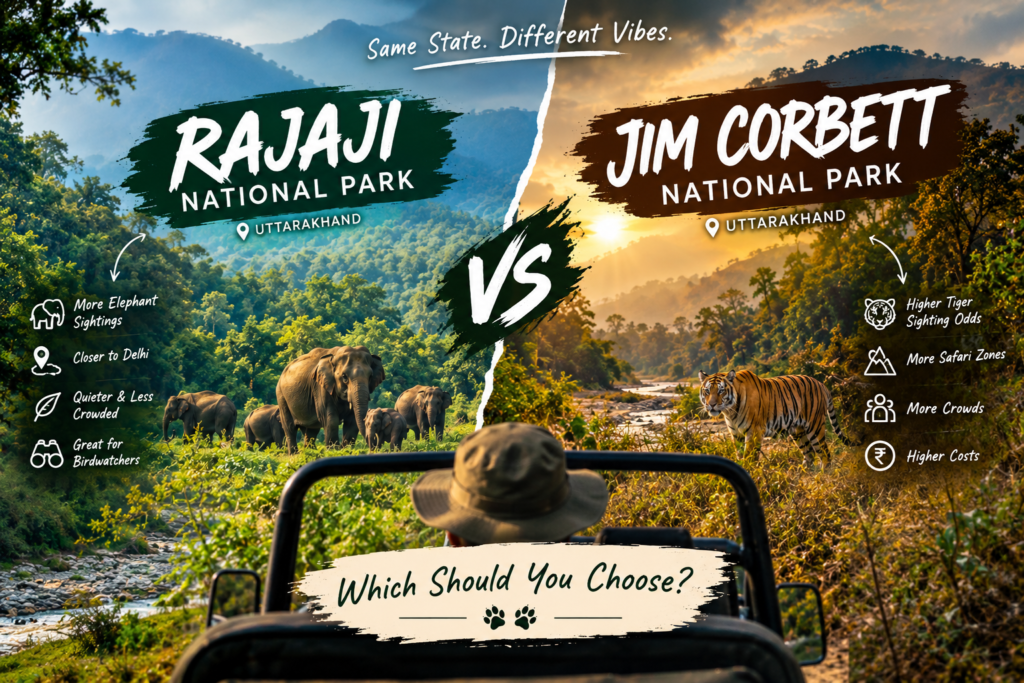
If you want the highest odds of a tiger sighting and don’t mind planning further ahead and paying more, choose Jim Corbett. If you want an easier, closer trip from Delhi, a quieter and less commercialized safari, strong elephant sightings, and a genuinely wild, less “touristy” atmosphere, choose Rajaji National Park. Neither is objectively “better” — they solve for different priorities.
Rajaji National Park vs Jim Corbett: Distance from Delhi
This is where Rajaji has a clear, practical edge. Rajaji National Park is about 230 km from Delhi, roughly 5 to 6 hours by road, with Haridwar and Rishikesh both under 15 km from the Chilla Gate. Jim Corbett, by comparison, sits further — typically a 6 to 7 hour drive, sometimes more depending on which zone gate you’re headed to and traffic on the way. If your trip window is a long weekend and you don’t want to burn most of a day each way in the car, Rajaji is the more realistic pick.
Rajaji National Park vs Jim Corbett: Sighting Odds
This is where Corbett generally wins, and it’s worth being upfront about it rather than oversell Rajaji’s tiger numbers. Corbett has a larger, longer-established tiger population and a higher density of tourism infrastructure built specifically around tiger sightings, which is reflected in its reputation as one of India’s most reliable tiger reserves. Rajaji, declared India’s 48th Tiger Reserve only in 2015, has a smaller but genuinely growing tiger population, and its real strength is elephants — it’s home to one of North India’s largest wild elephant herds, and elephant sightings in zones like Motichur and Ranipur are frequent and often dramatic. So the honest framing is: go to Corbett if a tiger sighting is your single priority; go to Rajaji if you want a strong overall wildlife experience with elephants as the highlight and tigers as a genuine possibility rather than a guarantee either way.
Rajaji National Park vs Jim Corbett: Cost
Corbett safaris tend to run more expensive across the board — jeep safari pricing there is often noticeably higher per vehicle than a comparable Rajaji gypsy safari, partly reflecting Corbett’s higher demand and more developed booking infrastructure. Rajaji’s park entry, gypsy hire and guide fees are generally lower, and because it’s less oversubscribed than Corbett, you’re also less likely to pay a premium just to secure a slot in peak season. If budget is a real constraint, Rajaji stretches further for a comparable multi-safari trip.
Rajaji National Park vs Jim Corbett: Crowds
Corbett’s popularity is a double-edged sword — it means excellent infrastructure, but also means Chilla-style crowding is common across most of its zones during peak winter, with gypsies queued at gates and sightings sometimes turning into a cluster of vehicles around one animal. Rajaji, even in its busiest zone (Chilla) and busiest months, is noticeably less crowded. If part of what you want from a jungle safari is a genuine sense of quiet and isolation in the forest rather than a convoy experience, Rajaji delivers that more consistently.
Rajaji National Park vs Jim Corbett: Is Rajaji Part of Corbett Tiger Reserve?
No — this is a common misconception worth correcting directly. Rajaji National Park and Jim Corbett National Park are two separate, independently administered tiger reserves in Uttarakhand. They are not the same protected area, and a permit or booking for one does not grant any access to the other. They do sit within the same broader Shivalik landscape and share some habitat characteristics, which is likely where the confusion originates, but administratively and geographically they are distinct reserves.
Rajaji National Park vs Jim Corbett: Zones and Variety
Corbett has more zones overall (Dhikala, Bijrani, Jhirna, Dhela, Durga Devi and others) and a wider range of terrain, from riverine belts to dense sal forest to open grassland, reflecting its larger total area. Rajaji’s six zones — Chilla, Motichur, Ranipur, Jhilmil Jheel, Mohand/Chillawali and Gohari/Ramgarh — are more compact but genuinely varied in their own right, ranging from Chilla’s dense forest and grassland to Jhilmil Jheel’s wetland habitat, which is a bird-watching draw Corbett doesn’t really match zone-for-zone.
Who Should Choose Rajaji National Park
- Travelers based in or visiting Delhi, Haridwar, Rishikesh or Dehradun who want an easy, low-effort trip.
- Anyone prioritizing elephant sightings over tiger sightings specifically.
- Birdwatchers, thanks to Jhilmil Jheel’s wetland habitat and 400+ recorded bird species.
- Budget-conscious travelers who still want a genuine tiger reserve experience.
- People who want a quieter, less commercialized safari with smaller crowds.
Who Should Choose Jim Corbett
- Travelers whose single priority is maximizing tiger sighting odds.
- Those planning a longer, multi-day wildlife trip who can absorb the extra travel time and cost.
- Visitors who don’t mind more crowded gates and jeeps in exchange for Corbett’s more established tiger-tourism reputation.
Can You Visit Both on the Same Trip?
Not comfortably in a single short trip — the two reserves aren’t close enough to each other to combine into one efficient itinerary, and each deserves at least a full day (ideally two safaris across two shifts) to be worthwhile. If your schedule allows a longer Uttarakhand trip, some travelers do split time between the two, typically visiting Rajaji first given its proximity to Rishikesh/Haridwar, then continuing on to Corbett separately.
Frequently Asked Questions
Is Rajaji National Park cheaper than Jim Corbett?
Generally yes. Rajaji’s park entry, gypsy hire and guide fees typically run lower than Corbett’s comparable safari costs, and it’s less prone to peak-season price premiums.
Which is closer to Delhi, Rajaji or Corbett?
Rajaji, at roughly 230 km and 5 to 6 hours by road, is noticeably closer than Jim Corbett, which typically takes 6 to 7 hours or more depending on the zone gate.
Is Rajaji part of Jim Corbett Tiger Reserve?
No, they are separate, independently administered tiger reserves in Uttarakhand, despite sharing a broader Shivalik landscape.
Which is better for elephant sightings, Rajaji or Corbett?
Rajaji is generally stronger for elephant sightings, home to one of North India’s largest wild elephant populations, particularly in the Motichur and Ranipur zones.
Which has better tiger sighting odds, Rajaji or Corbett?
Jim Corbett generally has higher tiger sighting odds due to a larger, longer-established tiger population and more developed tiger-tourism infrastructure.
Is Rajaji less crowded than Corbett?
Yes, even during peak season, Rajaji’s zones tend to see noticeably fewer vehicles and travelers than Corbett’s most popular zones.
Conclusion
Rajaji National Park vs Jim Corbett isn’t really a question of which reserve is “better” — it’s a question of what you’re optimizing for. Choose Corbett if tiger sightings are your non-negotiable priority and you can spare the extra travel time and budget. Choose Rajaji if you want an easy trip from Delhi, Haridwar or Rishikesh, strong elephant encounters, quieter zones, and a genuinely wild experience without Corbett-level crowds. If Rajaji sounds like the right fit for your dates, message us on WhatsApp and we’ll help you pick the zone that matches what you’re hoping to see.