
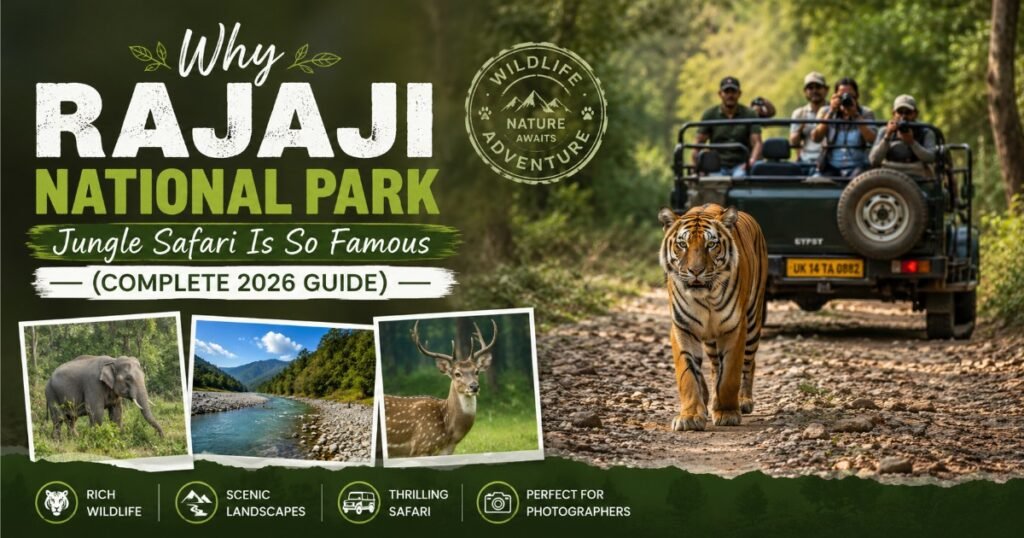
If you have been searching for “jungle safari near Haridwar and Rishikesh” or “best tiger reserve close to Delhi,” you have probably already stumbled upon Rajaji National Park. And there’s a reason its name keeps coming up — again and again — in every serious wildlife lover’s travel plan.
Rajaji National Park Jungle Safari has quietly become one of North India’s most talked-about wildlife experiences. It sits barely 15 km from Haridwar and around 30 km from Rishikesh, yet inside its 820+ sq. km of Shivalik forest, you’ll find Bengal tigers, over 500 wild Asian elephants, leopards, sloth bears, and more than 300 bird species — all without needing a long, expensive trip deep into the wilderness.
In this in-depth guide by Rajaji Jungle Safari, we’ll cover exactly why this park has become so famous, break down every safari zone, explain timings and charges, and answer the most common questions travellers ask before booking a safari.
1. Why Is Rajaji National Park So Famous?

A Tiger Reserve That’s Actually Easy to Reach
Most of India’s top tiger reserves — Corbett, Ranthambore, Bandhavgarh — require a long journey. Rajaji National Park breaks that pattern. Being just a short drive from Haridwar and Rishikesh means you can combine a spiritual trip to the Ganga ghats with a proper jungle safari in the same itinerary. This accessibility alone has made it one of the most searched wildlife destinations for travellers from Delhi NCR.
One of India’s Largest Wild Elephant Populations
Rajaji is known for hosting one of the healthiest wild Asian elephant populations in the country, along with being close to the north-western distribution limit for both the tiger and the elephant in India. Spotting herds of elephants crossing the Chaur grasslands or bathing near the Ganga belt is almost a signature Rajaji experience.
Official Tiger Reserve Status
Rajaji was declared a Tiger Reserve and now falls under Project Tiger, alongside being part of Project Elephant. This has led to stronger conservation efforts, better-managed safari zones, and a genuine (though never guaranteed) chance of tiger sightings — particularly in the Chilla zone.
Incredible Biodiversity in One Place
The park’s terrain shifts dramatically within a single safari — dense Sal forests, open Chaur grasslands, riverine belts along the Ganga, and marshy wetlands. This variety supports elephants, tigers, leopards, sloth bears, sambar and spotted deer, jungle cats, striped hyenas, and the rare swamp deer (barasingha) in the Jhilmil zone.
A Birdwatcher’s Paradise
With over 300 recorded bird species — including the Great Hornbill, Pied Hornbill, woodpeckers, and barbets — Rajaji regularly features on birding circuits, especially around Jhilmil and Mohand.
Less Crowded Than Other Reserves
Unlike Corbett or Ranthambore, Rajaji still feels wild and uncrowded, even during peak season. Multiple zones mean visitor pressure is spread out, giving each safari group a quieter, more immersive forest experience.
Multiple Zones = Multiple Experiences
This is one of the biggest reasons Rajaji keeps attracting repeat visitors — there isn’t just one safari route. Each zone offers a different landscape and different wildlife, so the same park can be explored again and again without repeating the experience.
2. Rajaji National Park Safari Zones — Complete Breakdown
Rajaji National Park is spread across Haridwar, Dehradun, and Pauri Garhwal districts, and is divided into several safari zones to manage tourist flow and protect the core habitat. Here’s a detailed look at each one.
Chilla Zone (Most Popular Safari Zone)
Located between Haridwar and Rishikesh, Chilla is the flagship zone of Rajaji National Park and the most sought-after jeep safari route. The safari runs through dense Sal forest and open Chaur plains, passing scenic stretches like Mundal, Mithawali, and Khara. This is the zone with the strongest odds for tiger and elephant sightings, along with leopards, spotted deer, sambar, langur, barking deer, jungle cats, and hornbills.
- Best for: Tigers, elephants, overall wildlife density
- Distance from Haridwar: Around 12 km
Motichur Zone
One of the oldest and most untouched zones, Motichur is known for its remarkable Sal forest cover and quieter, less crowded safari route. Elephants are a common sighting here, along with woodpeckers, hornbills, and barbets.
- Best for: Elephants, peaceful safari experience, birding
- Distance from Haridwar: Around 9 km
Jhilmil Zone (Jhilmil Conservation Reserve)
A unique buffer zone within the Haridwar Forest Division, Jhilmil combines forest tracks with views of the Ganga River. It is best known for its marshy wetlands and sightings of the rare swamp deer (barasingha), making it a favourite among serious birdwatchers.
- Best for: Birdwatching, barasingha, a calmer safari
- Distance from Haridwar: Around 15 km
Ranipur Zone
An offbeat, peaceful zone on the southern edge of the park, Ranipur is known for dense forest cover and strong leopard activity, along with rich general biodiversity.
- Best for: Leopard sightings, solitude
- Distance from Haridwar: Around 15 km
Mohand Zone
Located near Dehradun on the Saharanpur–Dehradun road, Mohand has a hillier terrain and dense forest cover, making it ideal for leopard sightings, occasional tigers, and wildlife photography.
- Best for: Leopards, hilly terrain, photography
Gohri Range (Year-Round Buffer Zone)
While the core zones close between June and November, Gohri Range typically remains open through the year, making it a good backup option for off-season travellers.
Other Entry Points
Depending on the season and forest department notifications, additional entries such as Asarori, Andheri, and the Satyanarayan/Kansro safari route (near the historic Shri Satyanarayan Bhagwan Temple) may also be operational. Since access changes from season to season, it’s always best to confirm current zone availability with Rajaji Jungle Safari before planning your visit.
3. Safari Timings, Season & Best Time to Visit
- Season: The core safari zones (Chilla, Motichur, Ranipur, Mohand, Jhilmil) typically open from mid-November to mid-June each year, while buffer areas like Gohri stay open year-round.
- Morning Safari: Roughly 6:00–7:00 AM to 10:00 AM (timing shifts slightly with sunrise)
- Evening Safari: Roughly 2:30 PM to 5:30 PM (timing shifts slightly with sunset)
- Best months: Winter and early spring (December–March) offer pleasant weather and good visibility, while the pre-monsoon summer months (April–mid-June) bring animals closer to waterholes, often improving sighting chances.
- Morning vs Evening: Morning safaris generally offer the best chance of spotting tigers, leopards, and elephants active after sunrise, while evening safaris are better for deer activity and golden-hour bird photography.
4. Rajaji National Park Entry Fee & Jeep Safari Charges
Costs are typically structured around a few components — entry fee (per person), Gypsy/jeep charge (per vehicle, shared among up to 6 people), guide fee, and an optional camera permit. Approximate ranges (always reconfirm current rates before booking, as Forest Department pricing can change):
| Component | Indian Nationals | Foreign Nationals |
|---|---|---|
| Entry Fee (per person) | ₹150 | ₹600 |
| Gypsy/Jeep Charge (per vehicle, up to 6 people) | ₹2,500 – ₹3,500 | ₹4,000 – ₹4,500 |
| Naturalist Guide Fee | ₹300 – ₹1,000 | ₹300 – ₹1,000 |
| DSLR Camera Permit | ₹200 | ₹500 |
| Children (5–12 years) | ~50% discount | ~50% discount |
Tip: Since the Gypsy charge is per vehicle and not per person, travelling in a full group of 6 significantly brings down the per-person cost — often making it one of the best-value wildlife experiences in India.
5. How to Book a Rajaji National Park Jungle Safari
- Decide your preferred zone — Chilla for tigers and elephants, Ranipur or Mohand for leopards, Jhilmil for birding and barasingha.
- Choose your slot — morning or evening — and your travel dates.
- Book at least 24 hours in advance, since popular zones like Chilla and Motichur fill up quickly, especially in peak season (December–March).
- Keep valid ID proof ready — Aadhaar/Voter ID for Indian nationals, passport for foreign nationals.
- Reach the gate at least 30 minutes before your slot to complete formalities.
For a hassle-free experience — zone selection, permits, guide arrangement, and pickup — Rajaji Jungle Safari handles the entire booking process end-to-end so you don’t have to navigate the paperwork yourself.
6. Wildlife You Can Spot on a Rajaji Safari
- Bengal Tiger
- Asian Elephant (500+ individuals)
- Leopard
- Sloth Bear
- Jungle Cat & Leopard Cat
- Striped Hyena
- Sambar, Spotted Deer, Barking Deer
- Barasingha (Swamp Deer) — mainly in Jhilmil
- Blue Bull (Nilgai), Wild Boar, Goral
- 300+ bird species including Great Hornbill, Pied Hornbill, woodpeckers, and barbets
7. Frequently Asked Questions (FAQs)
Q1. Why is Rajaji National Park so famous?
It’s famous for being one of the most accessible tiger reserves in North India, home to a large wild elephant population, six diverse safari zones, and rich biodiversity — all within a short drive of Haridwar and Rishikesh.
Q2. Which is the best zone for a Rajaji National Park jungle safari?
Chilla zone is considered the best overall for tiger and elephant sightings. Ranipur and Mohand are better for leopards, and Jhilmil is best for birdwatching and barasingha.
Q3. What is the best time to visit Rajaji National Park for a safari?
The core zones are open from mid-November to mid-June, with December to March offering the most pleasant weather, and April to mid-June often bringing better sightings near waterholes.
Q4. How much does a Rajaji National Park jungle safari cost?
Costs typically include a per-person entry fee, a per-vehicle jeep charge, and a guide fee. For Indian nationals, this usually totals somewhere between ₹400–₹700 per person when travelling in a full group, though exact rates should always be reconfirmed at the time of booking.
Q5. Can I use my own vehicle inside Rajaji National Park?
No. Only registered safari Gypsies with an approved naturalist guide are permitted inside the core safari zones.
Q6. How far is Rajaji National Park from Haridwar, Rishikesh, and Delhi?
Rajaji National Park is roughly 8–15 km from Haridwar, around 30 km from Rishikesh, and about 220 km (5–6 hours by road) from Delhi.
Q7. Is tiger sighting guaranteed on a Rajaji safari?
No sighting can ever be guaranteed in a wild forest. However, Chilla zone consistently ranks among the more reliable zones for tiger activity in North India.
Q8. How do I book a safari with Rajaji Jungle Safari?
You can reach out to Rajaji Jungle Safari directly for zone selection, slot booking, permits, naturalist guide arrangement, and pickup/drop assistance for a completely hassle-free jungle safari experience.
Plan Your Rajaji National Park Jungle Safari Today
From tiger territory in Chilla to the wetlands of Jhilmil, Rajaji National Park offers one of the most complete wildlife experiences in North India — and it’s closer than you think. Whether you’re combining it with a Haridwar-Rishikesh spiritual trip or planning a dedicated wildlife weekend, Rajaji Jungle Safari can help you choose the right zone, the right time, and the right safari for an unforgettable trip into the wild.
Ready to Book Your Rajaji Safari?
Check live slot availability across all five zones and secure your Jeep for the 2026 season.